
Five years without food

Hello-
This week I wrote about an animal that sounds made up, one that lives in the deep-sea and can survive more than five years without eating.
The deep-sea isopod is a giant relative of the garden pill bug. It has a flattened, segmented body, fourteen jointed legs, and a hard outer shell. Some deep-sea isopods grow nearly the length of your forearm. They live on the ocean floor, in a world that is cold, dark, pressurized, and almost entirely without reliable meals.
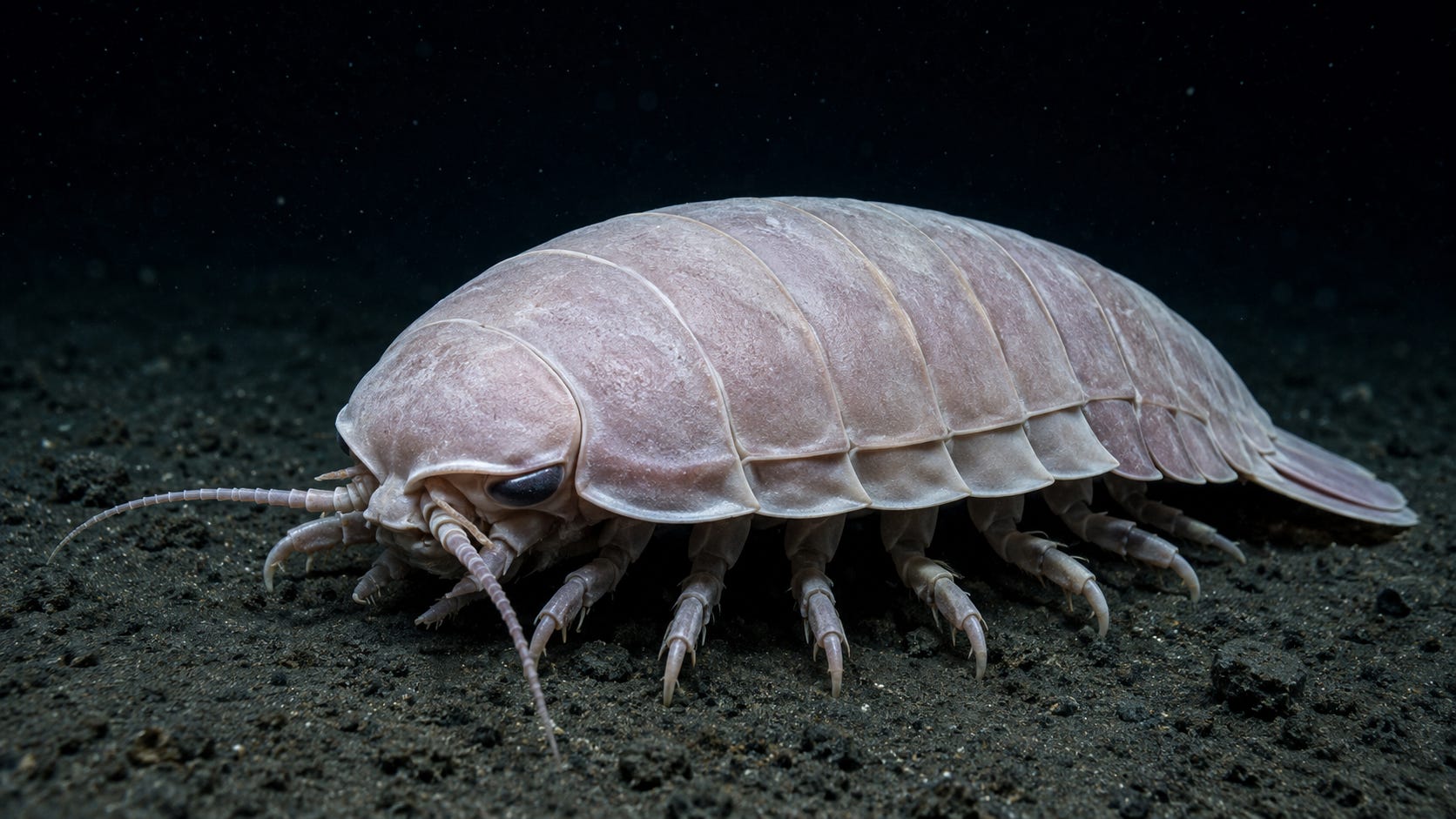
Food in the deep sea is scarce. Much of it falls slowly from above as marine snow: dead plankton and other organic material drifting down through dark water. Occasionally, something larger lands on the seafloor, such as a dead fish or a whale carcass. Then, for a brief time, there is a feast. After that, the famine returns.
A new paper in Cell explains how one of these animals survives this kind of life. The answer is a set of adaptations working together.
First, the deeper-dwelling isopod has an enormous stomach. In the study, it occupied roughly two-thirds of the body. When food appears, the animal gorges and stores it. Cut one open after a meal and you find a dense, almost fully digested paste with the consistency of mud.
Second, the animal lowers its metabolism dramatically. It runs its body on something close to standby mode. That is a remarkable solution to scarcity: eat heavily when food appears, then spend energy as slowly as possible.
The researchers found bacteria called Chlamydiae linked to fat storage in the deeper species. Many people know Chlamydiae because some members cause disease. Here, related bacteria may be helping a deep-sea animal bank energy for slow use.
Then there is a gene called ND1. It appears to have come from bacteria and entered the isopod lineage roughly 16 million years ago. Animals usually inherit genes from their parents. Borrowing genes from wildly unrelated microbes is rare, though genome sequencing has shown that it happens more often than biologists once imagined.
Inside the isopod, ND1 seems to help tune how the animal spends energy. When researchers put the gene into other animals, including zebrafish, it behaved in a context-dependent way. At ordinary temperatures, it sped metabolism up and made starvation harder to withstand. Under cold conditions meant to mimic the deep sea, it reversed course and extended starvation survival by 37 percent.
This animal survives through a stomach built for rare feasts, a metabolism suited to long famine, bacteria that may help store energy, and a microbial gene that helps control the burn rate in the cold. It is a whole survival economy built around waiting.
Isn’t biology amazing?
More soon,
Anirban